BOWLS OF WRATH

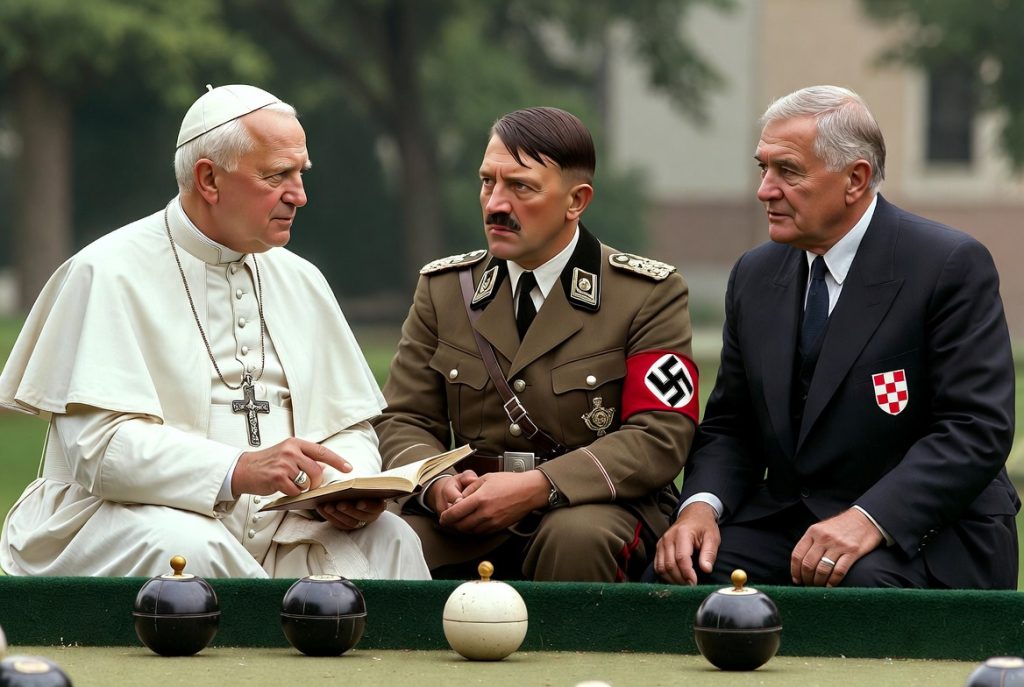
MOVIE TREATMENT Title: BOWLS OF WRATH Genre: Dark Satirical Comedy / Historical Absurdity Logline: In 1953 Argentina, two of history’s most wanted war criminals—Adolf Hitler and Ante Pavelić—kill time with lawn bowling under the bored protection of two Vatican priests who turn every match into a theological interrogation: if the Jews aren’t God’s chosen people, why did you two idiots lose the war?
Tone: Think The Death of Stalin meets Inglourious Basterds meets a very dark episode of Curb Your Enthusiasm. Polite, sun-drenched, and viciously funny.

Setting A faded, once-grand estate outside Buenos Aires—white stucco, bougainvillea, and a perfect, obsessively maintained bowling green that looks like an English village green dropped into the pampas. The house is technically “protected” by Perón’s government, but the only real minders are two Vatican priests living in the converted carriage house. Everyone pretends this is just a quiet retirement for “Herr Schmidt” and “Mr. Glavas.”

Main Characters

  • Adolf Hitler (68): Frail, half-deaf, teeth yellow, still insists on the little mustache. Obsessed with “form” in bowling. Calls the jack “the Führer of the green.” Rants in German when he loses.
  • Ante Pavelić (53): Stocky, ruthless, Croatian peasant charm hiding a butcher’s soul. Treats bowling like ethnic cleansing—aggressive, precise, zero mercy. Keeps a Luger in his bowling bag “for the Jews.”
  • Father Luca Rossi (42): Roman Jesuit, olive-skinned, sardonic, chain-smokes. The talker. Believes theology is best delivered while opponents are bent over measuring a bowl.
  • Father Karl Müller (49): German-born, former Wehrmacht chaplain turned Vatican “liaison.” Quiet, haunted, surprisingly good at bowling. He actually read the Talmud once.

Act One – The Green The film opens on a perfect Sunday afternoon. Hitler and Pavelić are already on the lawn in linen suits and straw hats, arguing over who invented lawn bowling (“The English? Lies. It was the Teutons!”). They play every day at 4 p.m. sharp. It is the only thing keeping them sane.

Two priests arrive—not dramatically, just carrying suitcases and a bottle of grappa. They explain they are “spiritual advisors” sent by certain friends in Rome who helped both men escape Europe via the ratlines. Their job: keep the guests alive, quiet, and out of the newspapers. Pavelić eyes them like cattle to be slaughtered. Hitler barely notices.

That first evening, during a casual triples game (priests vs. dictators), Father Rossi casually remarks while measuring a shot: “If the Jews are not the chosen people… why did you lose?”

The silence is so complete a distant cow can be heard chewing.

Act Two – The Conversion Tournament What begins as needling becomes a months-long theological cage match played out entirely on the bowling green. The priests never raise their voices. They quote scripture between bowls, drop Holocaust statistics like they’re discussing the weather, and remind the fugitives that every Allied victory was, statistically, “a statistical miracle if your racial theories were correct.”

Hitler counters with conspiracy theories about “international Jewry” and the weather. Pavelić screams about the “Serb-Jewish-Bolshevik hydra.” The priests answer with calm, devastating logic and better bowling technique.

Running gags:

  • Hitler’s bowl always drifts right (“The jack is controlled by Roosevelt!”).
  • Pavelić cheats outrageously and threatens to have the priests’ families “re-educated” back in Croatia.
  • The priests respond by quoting Deuteronomy while knocking his wood into the ditch.
  • Flashbacks are triggered every time someone says “chosen.” We see the Ustaše camps, the Wannsee Conference, mass graves—then smash-cut back to two old men in boaters arguing over millimeters on a manicured lawn.

Tension builds when a real threat appears: a young Israeli Mossad agent has picked up their scent. The priests, who have their own orders from Rome not to let the men be captured alive (too many embarrassing files), must now protect the very monsters they are trying to save.

Act Three – The Final End The climax is a single, rain-delayed lawn-bowling match that lasts an entire day and night. Hitler and Pavelić versus Rossi and Müller. No audience except fireflies and distant gauchos. The stakes: if the dictators win, the priests will help them disappear deeper into South America to start “Fourth Reich Bingo Night.” If the priests win, Hitler and Pavelić must kneel on the green and recite the Shema.

They bowl by lantern light. Hitler has a minor stroke mid-game but refuses to stop. Pavelić weeps—not from remorse, but because he realizes the priests are right about one thing: they lost. Completely. Utterly. Theologically, militarily, historically.

In the final frame, just before dawn, Hitler—trembling, face streaked with sweat—stands over the jack. He looks at Father Rossi and whispers in broken English: “…But we were so close.”

Rossi places a gentle hand on the old man’s shoulder. “Close only counts in bowling, mein Führer. And you still lost by three inches.”

Final Image The two priests walk back to the house as the sun rises. Behind them, Hitler and Pavelić remain on their knees on the green, reciting the Shema in halting, humiliated voices. The camera pulls back across the perfect lawn until the estate looks like just another quiet Argentine Sunday morning.

End titles (text on black): Ante Pavelić died in Madrid in 1959, never having recanted. Adolf Hitler’s death remains officially listed as 1945. The Vatican has never commented. Lawn bowling is still played in Buenos Aires every Sunday at 4 p.m.

FADE OUT.
SCENE: EXT. ESTATE VERANDA – LATE AFTERNOON, 1953

The sun hangs low over the pampas, turning the bougainvillea blood-red. The perfect bowling green stretches beyond the veranda like a green felt tablecloth. Two wicker chairs face each other. A small table holds two glasses of Fernet and a half-empty bottle. A portable radio plays faint tango music nobody is listening to.

ADOLF HITLER, 68, sits hunched in a cream linen suit two sizes too big, the ridiculous little mustache still dyed shoe-polish black. His hands tremble slightly as he polishes a wooden lawn bowl with a handkerchief.

ANTE PAVELIĆ, 53, stocky and sunburned, sprawls opposite him in shirtsleeves, sleeves rolled high enough to show the faded blue Ustaše tattoo on his forearm. A Luger rests openly on the table next to the ashtray like a paperweight.

HITLER (quiet, almost reverent, in thick Austrian German, then switching to accented English) They think it ended in the bunker. Fools. The real battalion never left Antarctica. New Swabia. Base 211. I signed the order myself in ’38. Three U-boats. Twenty-three hundred of our best. Engineers. Scientists. The ones who understood. They are still there, Ante. Under two kilometers of ice. Waiting.

PAVELIĆ (grinning like a wolf, Croatian accent thick as plum brandy) Of course they are. My boys in Zagreb heard the same thing through the ratlines. The priests think we are finished because Berlin burned and Zagreb fell. Pah! The final battalion never surrendered. They have the Vril technology now. Flying discs. The ones the Allies could never shoot down. They refuel on the ice shelf and fly straight up. Straight up, Adolf.

He mimes a rocket with his hand, then knocks back the rest of his Fernet.

HITLER (eyes lighting up, the old fire flickering) Exactly. Hydroponic farms. On the moon first. Yes, the moon, Ante. I have seen the photographs—smuggled out by our friends in the Vatican. Giant glass domes under the lunar dust. Potatoes. Wheat. Even tomatoes. No Jews to poison the soil. Pure Aryan agriculture. Self-sufficient. Eternal.

PAVELIĆ (leaving forward, conspiratorial) And Mars after that. The red planet. Our red planet. They landed the first module in ’47. I have the coded telegrams from Madrid. The soil is iron-rich. Perfect for the Master Race. They are growing Lebensraum up there right now—row after row of cabbages under red domes while the Americans play with their little rockets and cry about Sputnik. We never lost, my friend. We simply… relocated headquarters.

Hitler laughs—a dry, wheezing sound like a broken accordion.

HITLER Relocated. Yes. The war is not over. It has only gone vertical. When the time is right—when the stars align again—the final battalion will descend. From the ice. From the moon. From Mars. They will land on this very lawn and say, “Mein Führer, the hydroponic tomatoes are ready. The Fourth Reich requests instructions.”

PAVELIĆ (slapping the table so the Luger jumps) And we will give them instructions! First, Buenos Aires. Then Jerusalem. Then the moon again for victory parades. The chosen people? We are the chosen people. God just needed seventy million casualties to realize it.

A long beat. The tango on the radio swells ironically. Hitler stares into the middle distance, polishing the bowl until it gleams like a skull.

HITLER (soft, almost tender) Do you ever wonder if the priests know?

PAVELIĆ (shrugs, reloading his glass) The Jesuits? They know everything. That is why they keep us alive. Insurance. In case the Martians need a blessing before the invasion.

They clink glasses. For a moment they look almost peaceful—two old men on a Sunday afternoon dreaming of galactic cabbages.

HITLER (raising his glass to the sky) To Base 211. To the moon. To Mars. And to the tomatoes that will bury the Bolsheviks.

PAVELIĆ To the tomatoes.

They drink. The camera drifts slowly upward, past the veranda, past the perfect green, until the entire estate looks small enough to fit inside one of those imaginary lunar domes.

FADE TO GREEN.

SCENE: EXT. ESTATE BOWLING GREEN – TWILIGHT, 1953

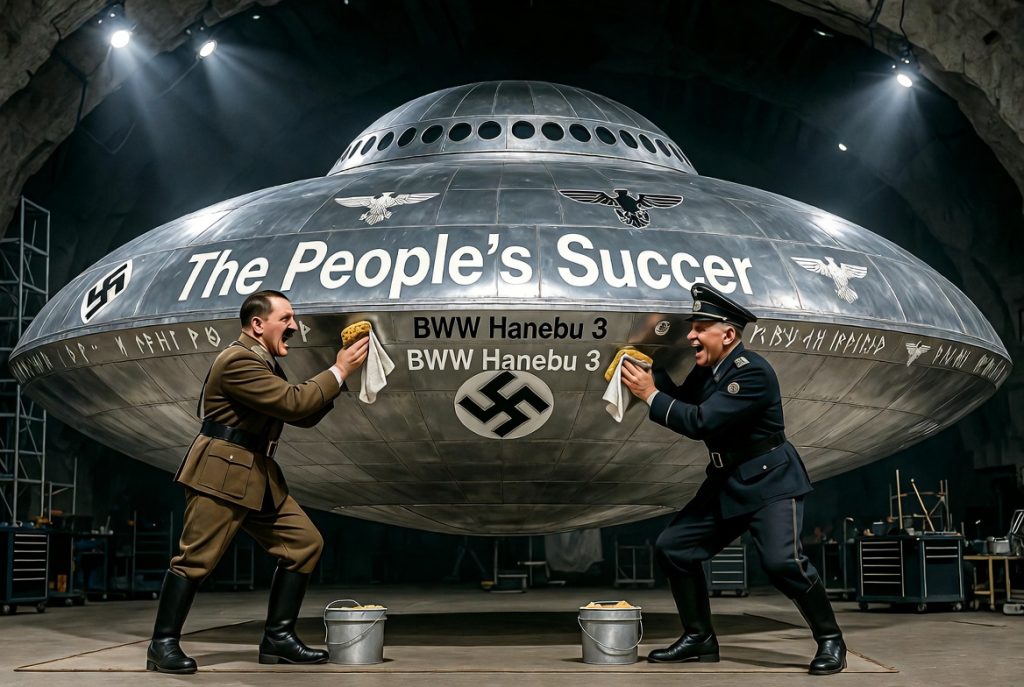
The last of the sun bleeds across the pampas, painting the perfect lawn a bruised violet. The two wooden bowls and the white jack sit forgotten in the grass like abandoned planets. A rickety card table has been dragged onto the green. On it: a half-finished bottle of Fernet, two cloudy glasses, and a dog-eared, smuggled technical drawing—yellowed paper covered in faded pencil lines and swastikas. The heading, in Gothic script, reads:

DER VOLKSWAGEN DER LÜFTE BMW HANE BU III – THE PEOPLE’S FLYING SAUCER

ADOLF HITLER, 68, hunches over the drawing, one trembling finger tracing the saucer’s ring of glowing portholes. His linen jacket is unbuttoned; the little mustache twitches with each excited breath.

ANTE PAVELIĆ, 53, leans back in his chair, boots up on the table, Luger across his lap like a sleeping cat. A half-smoked cigar smolders between his teeth.

HITLER (voice low, reverent, almost whispering in German before switching to accented English) Look at her, Ante. The People’s Flying Saucer. Not some toy for the Luftwaffe fat cats. No. This one was for us. BMW built the prototype in ’44 under the strictest secrecy. Hanebu III. Thirty meters across. Anti-gravity plates reverse-engineered from the Vril discs. They told me the test flight over the Baltic reached Mach 7 before the pilot even felt the acceleration. Mach seven. The Allies never saw her coming.

PAVELIĆ (grinning, tapping ash onto the grass) My Ustaše couriers brought the same blueprints out of Prague in a priest’s suitcase. The Jesuits knew. They always know. BMW engineers—good German boys—welded the final hull in the tunnels under the Harz Mountains. Triple-layered hull. Tesla coils on the rim. She doesn’t fly, Adolf. She defies. The priests in Rome called it “demonic.” I called it dinner. We were going to drop one over Moscow on May Day 1945. One saucer. One city. Gone.

Hitler’s eyes glaze with the old fever. He smooths the paper as if it were a sacred relic.

HITLER We did drop them. Three Hanebu IIIs left Peenemünde in April. Two went to Base 211 in New Swabia. The third… the third is already on the dark side of the moon. Hydroponic command center. The final battalion pilots her every night, just to keep the batteries warm. When the time comes they will swing her around the Earth like a scythe. Buenos Aires first—for old times’ sake. Then Tel Aviv. Then Washington. The People’s Flying Saucer will finish what the V-2 only started.

PAVELIĆ (slapping the table, making the glasses jump) And BMW never stopped production! The factories are underground now. On Mars. Red dust for camouflage. The workers wear the same blue overalls they wore in Munich—except now they breathe recycled air and grow cabbages under glass. I have the manifest, Adolf. Forty-seven saucers completed since ’48. Forty-seven. Each one carries two hundred of our finest. They are waiting for the signal. One word from us and the sky over this pathetic lawn will fill with silver discs spinning like tops.

Hitler suddenly stands—shaky, but upright—staring up at the first stars appearing above the bougainvillea.

HITLER The priests will laugh. “You lost,” they say. Lost? We simply moved the factory to the stars. The Hanebu III is not a weapon, Ante. She is the new Volkswagen. Every Aryan family on the lunar colonies will have one. Sunday drives around the Sea of Tranquility. Picnics on Olympus Mons. No Jews. No Bolsheviks. Just clean, silent, anti-gravity flight and the smell of sauerkraut from the hydroponic kitchens.

PAVELIĆ (raising his glass toward the darkening sky) To the People’s Flying Saucer. To BMW. And to the day she lands right here—right on this fucking bowling green—and the priests have to kiss our boots while we board her for the victory parade around the moon.

Hitler clinks his glass against Pavelić’s. For a moment they stand in silence, two old men in straw hats gazing upward as if they can already hear the low, electric hum of thirty-meter silver discs descending through the Argentine night.

HITLER (soft, almost tender) They will paint her name on the side in big red letters: Volksscheibe. The People’s Saucer. And the world will finally understand who really won.

A single firefly drifts between them like a tiny, lonely running light.

FADE TO BLACK.

Defending Our Homeland

Brothers and sisters,

Today I stand before you not as someone above you, but as one of you—a son of our homeland, shaped by its soil, its struggles, and its spirit. My name is Jozo Jukic, and like you, I carry Croatia in my heart.

Our homeland is not just lines on a map. It is the echo of our ancestors’ footsteps, the prayers whispered in our churches, the sweat of workers, the laughter of children, and the sacrifice of those who came before us. It is everything we are—and everything we must protect.

We are a small nation, yes. But history has shown that size does not define strength. Unity does. Courage does. Faith in one another does.

There will always be voices that try to divide us—by region, by background, by politics, by fear. But we must reject that. Because when we stand divided, we are weak. When we stand together, we are unbreakable.

Defending our homeland does not only mean standing on a battlefield. It means defending our values. It means building a country where justice matters, where hard work is rewarded, where our culture is preserved, and where our children can live with dignity and hope.

Courage is not the absence of fear. Courage is choosing to stand firm despite it. Our people have faced hardship before—war, struggle, uncertainty—and we endured. Not because we were fearless, but because we refused to give up on each other.

So I say to you now: stand tall. Stand united. Stand proud.

Let no one tell you that our future is already written. We write it—together.

With unwavering courage in our hearts and unity in our hands, we will protect what is ours, honor those who came before us, and build something worthy of those who will come after.

For our homeland. For our people. For Croatia.

Hvala vam.

Croatian Political News: April 27th, 2026

Here’s a clear roundup of today’s Croatian political news (April 27, 2026) and the most relevant developments from the past few days:


🗞️ Latest Croatian political news

SeeNews

Croatia licences White Tech as crypto asset service provider

Today

Alexandru Munteanu attends the Three Seas Initiative Summit

radiomoldova.md

Alexandru Munteanu attends the Three Seas Initiative Summit

Today

The evolution of the Three Seas Initiative

Atlantic Council

The evolution of the Three Seas Initiative

4 days ago

Croatia updates Foreigners Act to align with EU migration ...

Croatia Week

Croatia updates Foreigners Act to align with EU migration …

4 days ago

Zimmer Frei: Croatia’s Weird Private Accommodation Problem

Total Croatia

Zimmer Frei: Croatia’s Weird Private Accommodation Problem

Yesterday

1) Croatia hosting major geopolitical summit

  • Croatia is hosting the Three Seas Initiative Summit in Dubrovnik (April 27–29).
  • Leaders from Central & Eastern Europe, plus U.S. and EU representatives, are attending.
  • The summit focuses on:
    • energy security
    • infrastructure
    • digital cooperation
  • U.S. officials are also present to strengthen political and economic ties.

👉 This is the biggest political event in Croatia right now and puts the country at the center of regional strategy.


2) New migration law aligning with EU rules

  • The government has proposed changes to the Foreigners Act.
  • Key points:
    • stricter labor and permit rules
    • language requirements
    • alignment with the upcoming EU Migration Pact

👉 This reflects Croatia tightening immigration policy while staying aligned with Brussels.


3) Crackdown on tourism “grey market”

  • A new law targeting unregistered private accommodation rentals is coming.
  • This affects:
    • landlords
    • tourism income
    • local housing markets

👉 Politically sensitive because tourism is a major part of Croatia’s economy.


4) Economic governance & regulation (crypto sector)

  • Croatia’s regulator approved a new crypto-asset service provider licence.

👉 Shows the government is:

  • regulating fintech more actively
  • aligning with EU digital finance rules

🧭 Other important recent political developments

Military policy shift

  • Croatia has reintroduced compulsory military service (voted earlier, now being implemented).

Demographic crisis response

  • A new government-backed plan aims to:
    • boost birth rates
    • encourage diaspora return
    • reverse population decline

Regional tensions

  • Diplomatic friction with Montenegro over WWII Jasenovac commemoration continues.

🧠 Big picture

Right now, Croatian politics is focused on:

  • Geopolitics: hosting major regional summit
  • Migration control: aligning with EU rules
  • Economic regulation: crypto + tourism sector
  • Security: return of conscription
  • Demographics: long-term population decline

Quarantine Croatia

An empty cloister at night. Rome is quiet under curfew lights. Dr. Luka Kovač stands by an open window, the bells long finished ringing. Lenny Belardo, the Young Pope, sits barefoot in a chair, smoking, eyes sharp.


DR. LUKA KOVAČ:
You know what scares me, Holy Father? Not disease. I’ve seen enough of it. What scares me is delay. Hesitation kills more people than any virus.

LENNY BELARDO:
You doctors always say that, then you wait for permission. From governments. From markets. From Babylon.

LUKA:
Babylon is exactly the problem. New York, London, the great airports of the world—hubs of money, sin, and laboratories that play God. Wuhan was not an accident. It was a warning shot.

LENNY:
You’re saying the next plague is already incubating?

LUKA:
I’m saying history repeats itself when arrogance goes unrepented. Croatia survived empires, sieges, storms. But only because people knew when to retreat to the hills. The diaspora must come home. Now. Quarantine. Before the next laboratory plague escapes its cage.

LENNY (smirks):
You want to shut the borders of the world and reopen the village.

LUKA:
I want to save lives. The diaspora carries skills, memory, faith. Bring them back, isolate, test, cleanse. Forty days if necessary. Like the desert. Like Lent.

LENNY (stands, suddenly serious):
You know what Scripture says about that instinct?

LUKA:
I know what Revelation says about plagues.

LENNY:
No. About escape.

(He walks to the altar, touches it lightly.)

LENNY (quoting):
“Then I heard another voice from heaven say: Come out of her, my people, so as not to take part in her sins and receive a share in her plagues.”

LUKA:
Revelation 18:4.

LENNY:
Yes. God’s quarantine order.

LUKA:
Exactly. Come out of her. Out of Babylon. Out of the megacities that think they’re immortal.

LENNY:
And if they don’t?

LUKA:
Then they share in her plagues. And her fires.

LENNY (quietly):
And her nukes.

(A pause. The word hangs heavy.)

LUKA:
New York doesn’t understand fragility. It thinks money is immunity.

LENNY:
Money is a false vaccine.

LUKA:
Croatia still remembers hunger, siege, neighbors disappearing overnight. That memory is a form of health.

LENNY:
You’re asking me to bless a mass exodus.

LUKA:
I’m asking you to call people home. Not to comfort—but to discipline. Quarantine is not punishment. It’s love with boundaries.

LENNY:
You sound like God on Sinai.

LUKA:
No. I sound like a doctor who has zipped too many bags.

LENNY (after a long silence):
If I say this aloud, they’ll call me insane.

LUKA:
They already called Noah insane. Right up until it started raining.

LENNY (turns back, eyes fierce):
Then we say it plainly. Not softly. Not diplomatically. We say: Come out. Come home. Wash. Wait. Pray. Plant gardens. Learn each other’s names again.

LUKA:
And if Babylon mocks?

LENNY:
Babylon always mocks before it burns.

(The bells begin to ring again, slow and deliberate.)

LENNY:
Prepare your people, Doctor. If the plague doesn’t come, they’ll say we were fools.

LUKA:
And if it does?

LENNY:
Then Croatia becomes an ark.

(They stand together, listening to the bells, as the lights dim.)

Monkey Pox Prophecy

Lenny Belardo stands alone beneath the frescoes, his voice low, precise, almost bored by apocalypse.

“You see, they no longer need swords. Swords are honest. Swords admit violence.
What they prefer now is cleanliness. Sterility. A disease with a press release.”

He smiles thinly.

“Monkey pox. Small words. Small lesions. Small excuses. And yet Revelation has always loved the small things — the sores, the boils, the quiet punishments that bloom on the skin when humanity believes it has finally escaped judgment.”

He taps the Bible with one finger.

Revelation 16:2.
‘Ugly and painful sores broke out on the people who had the mark of the beast.’
Not fire. Not thunder. Skin. Visibility. Shame. A judgment you cannot hide behind a suit.”

Lenny looks up, eyes cold.

“The Illuminati — a vulgar name for a very boring truth — do not worship Satan. They worship inevitability. They read Revelation not as prophecy, but as a to-do list.
If people believe judgment is coming, all you have to do is stage-manage the symptoms.”

He walks slowly now.

“And then there is Revelation 18:8.
‘Plagues will overtake her in a single day — death, mourning, and famine.’
Babylon never falls by bombs. Babylon collapses by paperwork, quarantines, shortages, fear dressed as compassion.”

A pause.

“They want fulfillment without repentance. Apocalypse without God. A theater of collapse where no one asks why, only who is allowed to move.

Lenny exhales, almost a laugh.

“But they misunderstand something crucial.
Revelation is not a manual for tyrants. It is a mirror.
The sores appear not because God is cruel — but because corruption eventually becomes visible.”

He closes the Bible.

“You cannot fake salvation.
You cannot manufacture the Kingdom.
And you cannot weaponize plagues without eventually infecting yourselves.”

A final glance toward the altar.

“Babylon always believes it is immune.
That is why it falls in one day.”

Let’s Go Crazy

Mary had always carried mysteries in her heart. From the moment the angel spoke, from the shepherds and Magi bowing low, she knew her son was marked for something vast—too vast for this world. But knowing a prophecy and watching it unfold are two different things.

So when the crowds grew thick around Him, when the rumors spiraled—He heals the blind, He casts out demons, He forgives sins like He owns the place—a mother’s fear naturally rose with them.

Scripture says plainly that His own relatives went out to seize Him, “for they said, ‘He is out of His mind.’
Mary stood among them. Not because she doubted God, but because she feared what humans do to men who speak like prophets and act like kings.

She saw Him teaching in the doorways of fishermen’s houses, skipping meals, surrounded by the desperate, the diseased, the possessed. She saw the scribes watching Him with cold eyes, sharpening laws into knives. She saw the crowds pressing, pulling, demanding more and more from her son—her boy who once scraped His knees on Nazareth’s stones.

And deep inside her heart rose a cry only a mother can carry:

“My son, you are going to get yourself killed.”

When she came with His brothers to bring Him home, He didn’t bow to her fear.
He lifted His eyes to the crowd instead and said,
Who is my mother, and who are my brothers?
Those who do the will of my Father are my family.”

It wasn’t rejection—it was revelation.
But to Mary, in that moment, it felt like watching Him step beyond her reach forever.

She thought He was risking everything.
She thought the world would crush Him.
She thought He had stepped into madness—the divine kind that refuses to obey earthly limits.

Only at the foot of the Cross would she finally understand:

He wasn’t crazy.
He was fulfilling destiny.

And the pain she feared came true—not because He was out of His mind, but because He was out of this world.

Riders on the Storm 2

Joe Jukic’s Speech: “After the Storm, the Fog”

Brothers and sisters, domovina calls.

My family was in Croatia during Operation Oluja—Operation Storm—when thunder rolled across our homeland and the invaders fled before the courage of ordinary people. But after the storm came another weather, darker and stranger: a new fog of war—the one they don’t teach in schools.

Because when the smoke cleared and soldiers returned home, the New World Order descended. Not with tanks. Not with aircraft.
But with courtrooms, indictments, and chains.
With kangaroo courts that put our heroes on trial while the real architects of chaos sat in leather chairs in Washington, London, and Brussels.

They tried to rewrite our victory.
They tried to shame our defence.
They tried to put a nation of David on trial for standing against Goliath.

And I—Joe Jukic—looked at that injustice and said:

“If the world will not give us a fair court, I will build my own.”

So I began my courtroom on the internet, the free frontier they could not censor, where truth still breathes.
And from that digital pulpit I opened the case that no Hague judge dared to touch:

The Judgement of Yale.
The indictment of the Brotherhood of Death.
The Skull & Bones cabal whose hands are deep in every conflict from the Balkans to the Middle East.

While they chained Croatian generals, I cross-examined their wars, their oil pipelines, their secret lodges.
While they called our veterans criminals, I put their false kings—the Bush dynasty and its New World Order—on trial before the nations.

Storm liberated our land.
But truth will liberate our future.

And I vow this:
As long as I breathe, as long as a Jukic still stands on this earth,
the heroes of Croatia will never again be judged by foreign tyrants—
only by God, by history, and by the people they bled for.

Economic Suffering

Joe Jukic steps forward, Dusan beside him, and the crowd of Croatians quiets.

JOE JUKIC:
Brothers and sisters… our homeland has suffered long enough.
Every morning we pray Oče našforgive us our debts, as we forgive our debtors.
Yet twenty-five years after the Jubilee, the lords of finance — these Judas sons — still refuse to forgive our debts.
They preach morality while chaining the working people to interest, to anxiety, to endless labor.
But hear me today: this will change.

DUSAN JUKIC:
We are the sons of a small but stubborn nation… a nation that survived empires, invasions, and poverty.
If Croatia survived the sword, we will survive the spreadsheet.
If our ancestors broke chains of steel, then we will break chains of debt.

JOE JUKIC:
We propose something simple, fair, and blessed:
A national debt jubilee — a cleansing of the books —
A return to the justice God intended when He commanded that debts be forgiven and land restored.
If the elites will not do it voluntarily, then we will do it by law.
No more families breaking under compound interest.
No more youth emigrating because the banks have taken tomorrow hostage.

DUSAN JUKIC:
And hear this too:
Croatia will work four days a week
Not because we are lazy, but because we are wise.
Because machines have replaced labor, but wages have not risen.
Because the work of one man now equals the work of many.
A four-day week means 20% more jobs,
which means families staying together,
villages alive again,
and full employment by design, not by accident.

JOE JUKIC:
Let us lead, and we promise you rest from your labors.
Not idleness — but dignity.
Not poverty — but peace.
For I am humble of heart, and my yoke is easy.
Walk with us, and we will lift the burdens off your backs —
the burdens placed there by those who worship profit more than people.

DUSAN JUKIC:
A new Croatia is not only possible…
It is necessary.
It is righteous.
It begins today.

JOE & DUSAN together:
Bog i Hrvati — and may God bless the free, unburdened future of our nation.

Time to Return

Joe Jukic stood on the old fortress wall above the Dalmatian coast, the wind cutting sharp off the sea. Below him, the black-flagged HOS battalion stood in formation—young, old, veterans, sons of veterans, and grandsons of men who had fought in ’41 and ’91 alike.

Joe raised his voice—firm, ragged, and unmistakably diaspora-born, yet carrying the rhythm of the homeland.


JOE JUKIC’S SPEECH TO THE HOS

“Braćo…

You know my story. I was born far from here—under neon skies, in a land where our names are mispronounced and our saints forgotten. A land where our fathers broke their backs so we could eat. A land where our mothers cried into pillows for the home they lost.

But Croatia never left us.
Not in exile.
Not in shame.
Not in silence.

We—the diaspora—were scattered like seed. But seed is only waiting for the right season.

And that season is now.

Look around you… Dalmatia is calling her sons and daughters back.
Look at the mountains… they still wear the same scars from Vukovar to Škabrnja.
Look at the sea… it still reflects the same blue our grandfathers looked upon before marching to their fate.

We are not here to take glory.
We are not here to replace those who stayed and bled on this soil.
We are here because all Croats are one nation, no matter where destiny sent us.

In Canada they gave me pharmakeia to keep me quiet.
Here—you give me purpose.

In Babylon they told us we were alone.
Here—I stand in front of warriors who would die for each other.

They thought we forgot who we are.
They thought exile would turn us soft.
But the diaspora has iron inside it—iron hardened by survival, by distance, by yearning.

Brothers…

The time has come for us to return home—not as tourists, not as second-hand Croats, but as the missing battalion that history kept in reserve.

Croatia doesn’t need more empty words.
She needs her lost sons back.
She needs her daughters’ hands rebuilding these villages.
She needs our children raised speaking the tongue of their ancestors.

We are done living in foreign cages.

If you want to live like lions, live where your ancestors hunted.

If you want to live free, live where your own blood is the soil.

Dijaspora… braćo…
Now is the hour.
Now is the return.
Now is the homecoming.

Za Dom…!”

And the HOS roared back with one voice that shook the stones:

SPREMNI!

Hrvatska