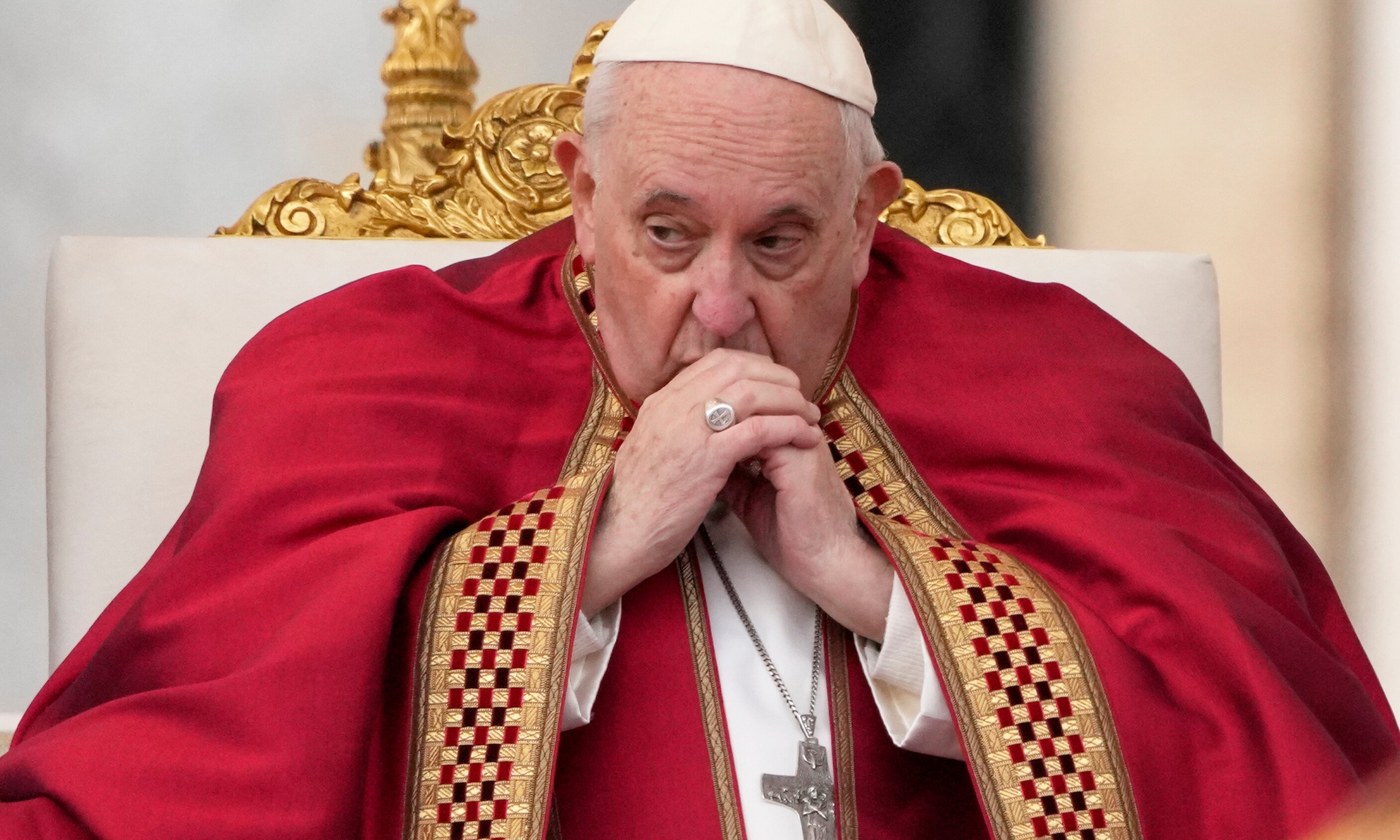
Palm Sunday Money Lenders

Palm Sunday Homily by Pope Pius XIII (Lenny Belardo)

St. Peter’s Basilica – Palm Sunday Mass

(Lenny stands before the crowd, clothed in white and gold, holding high a palm branch. His eyes are fierce, his voice tender yet thunderous, magnetic and absolute.)

“Dear brothers and sisters,”

Today, as the people of Jerusalem waved palm branches and cried out Hosanna, they did not yet know the cost of peace. They saw in Jesus a king—riding not on a warhorse but a humble donkey. A king of paradox. A king of peace.

And yet… within a few days, this same gentle king—this lamb of God—would storm the temple, fashion a whip from cords, and drive out the moneylenders.

Why?

Because usury is a lie.

Because lending money at interest to the poor is not generosity. It is theft with a polite face.

It is the soft tyranny of the ledger, the quiet oppression of compounding misery.

The temple was meant to be a house of prayer. Instead, it had become a market of manipulation, where the poor were taxed in God’s name, and the rich sold doves at double price so peasants could pretend to atone. Jesus saw through the piety. He saw the con.

And so he made a whip.

He didn’t whisper. He didn’t compromise. He flipped the tables.

My children, the same tables are still standing. The modern temple is the bank. The house of God is in foreclosure. And those who seek salvation are handed forms, interest rates, and a lifetime of servitude.

Usury is not an economic theory. It is sin.
It is sin because it thrives on fear.
It is sin because it puts price tags on mercy.
It is sin because it profits from despair.

Jesus chased the moneylenders because He was not tame. Because love, real love, has teeth. He did not die so that a man could be born only to labor under debt his entire life. He did not rise so the world could worship the dollar and call it destiny.

Palm Sunday is not just the triumph of Christ’s entry. It is the beginning of war—against lies, against greed, against the golden calf the world kneels to even now.

So today, let us wave our palms not just in memory, but in defiance.
Defiance of the lie that says: “This is just how the world works.”
No. This is how the world breaks.

And Christ came to make it whole again.

Hosanna in the highest. Blessed is He who comes to turn over every table.

Amen.

(Lenny steps down from the pulpit slowly, the crowd silent, as if stunned. Some weep. A few nod with clenched fists. Somewhere, in a Vatican back office, a banker starts to sweat.)

Christian Socialism

TITLE: The Tenets of Sharing


INT. VATICAN – NIGHT

The grand hall of the Vatican is quiet, the stone walls echoing with a sense of history. Pope Pius XIII, dressed in his white robes, stands at a large wooden podium, addressing a small group of trusted advisors and leaders. His gaze is intense, his voice calm but commanding.

POPE PIUS XIII
(softly but firmly)
“Democracy is not simply a system of government. It is a moral imperative. And Christian socialism, the kind of socialism that bears the teachings of Christ, is not about taking away from the rich or punishing the powerful—it is about sharing. Sharing everything. Sharing the fruits of labor, the wealth of the land, and most importantly, sharing power.”

He pauses, letting the weight of his words sink in. His eyes scan the room, looking each advisor in the eye.

POPE PIUS XIII
“Jesus Himself taught us that to be great in the Kingdom of God, one must be the servant of all. What does that mean, if not to serve the people? To share power, not hoard it? To lift up those who are weak, poor, and oppressed, so that all may have an equal chance at the riches of life—whether they be material or spiritual.”

The advisors shift uncomfortably, some nodding in agreement, others skeptical. Pope Pius XIII’s tone grows more impassioned.

POPE PIUS XIII
“We have failed if we allow power to remain concentrated in the hands of the few. We have failed if the wealth of the world, the resources that God has provided, are hoarded by the privileged while the many suffer. It is not enough to give charity. Charity is not justice. Justice demands that we redistribute—not just wealth, but the very power that governs us.”

He steps away from the podium, walking slowly toward a large map of the world on the wall. His finger traces the continents, the countries, the boundaries.

POPE PIUS XIII
“We must create a world where power is not a tool for oppression, but a means of lifting others. Where the powerful do not rule over the weak, but share in the burden of governance. A world where the decisions made in the halls of power are not about maintaining the status quo, but about creating a society that is just, equitable, and loving.”

He turns back to the group, his eyes fierce, his voice steady.

POPE PIUS XIII
“This is the vision of democratic Christian socialism. It is not a utopia. It is a call to action. A call to share, to serve, to give. To ensure that all, no matter their station in life, have access to the blessings of this earth. And that power, the most dangerous and corrupting force, is shared equally among all.”

He pauses, letting the silence fill the room.

POPE PIUS XIII
“Do not let the world tell you that power is meant to be hoarded. Do not let the systems of wealth and privilege convince you that some are born to rule while others are born to serve. In the eyes of God, we are all His children, and we are all meant to share in the blessings He has given us.”

The advisors sit in stunned silence, some visibly moved, others deep in thought. Pope Pius XIII’s gaze softens, his voice quieter but no less resolute.

POPE PIUS XIII
“It is time for us to lead by example. To show the world that true power lies in service, in sharing, in love.”

He turns and walks toward the door, his robes flowing behind him. The room remains still, the weight of his words hanging in the air.


FADE OUT.

Oluja/Storm 91 – 99

“Dear brothers and sisters, today I speak not only as the shepherd of this Church but as a son of a land that has known the pain of war. I speak as a Croatian, born from a soil soaked in tears and resilience. And I speak as one who remembers.

The war in my homeland was not a distant conflict; it was the air we breathed, the ground we walked upon, the songs that were silenced. Operation Storm—Oluja, as we call it—was a turning point, a storm that swept through the land, bringing both liberation and loss. It was a moment of triumph for some, and a wound that remains unhealed for others.

War, my friends, is a crucible of the human soul. It reveals the depths of our brokenness, the ease with which we can turn against one another. But it also reveals the strength of the human spirit, the capacity to endure, to rebuild, to forgive. In the midst of devastation, I saw neighbors sharing their last loaf of bread, soldiers laying down their weapons to carry children to safety, prayers whispered in bomb shelters. These moments of grace remind us that even in the darkest night, the light of Christ shines.

But let us not romanticize war. Let us not glorify its violence or justify its destruction. As a Croatian, I know too well the cost of freedom. I know the names of the villages that no longer exist, the faces of the children who never grew up, the silence of the churches that once rang with hymns. These are the scars my homeland bears, and they are the scars I carry in my heart.

Yet, as a Christian, I also know the power of resurrection. The story of Croatia, like the story of our faith, is not one of despair but of hope. From the ruins of war, we have rebuilt homes and lives. From the ashes of division, we have begun to sow the seeds of reconciliation. This is the work of God’s Spirit, moving among us, calling us to be peacemakers, to be healers, to be builders of a new future.

The Gospel calls us to love our enemies, to pray for those who persecute us. This is not an easy command. It is not a command that erases the pain of the past or denies the reality of injustice. But it is a command that frees us from the cycle of hatred, that opens the door to a peace that is not of this world.

Today, I call on all nations, all peoples, to learn from the wounds of my homeland. Let us not repeat the mistakes of the past. Let us not allow pride, greed, or fear to lead us into conflict. Instead, let us be instruments of peace, guided by the love of Christ.

And to my fellow Croatians, wherever you may be, I say this: Remember the storm, but do not let it define you. Remember the pain, but do not let it consume you. Remember the loss, but do not let it rob you of hope. For we are a people of the resurrection, and our story is not over. The God who brought us through the storm will bring us to a place of peace.

May God bless Croatia, may God bless all nations, and may His peace reign in every heart.”

Riders on the Storm

The Young Pope’s Monologue:

“Brothers and sisters, let us speak of war—not as a distant shadow of history, but as a mirror reflecting the desires of men. In 1991, the world watched as the powerful descended upon the sands of Babylon. A coalition forged not by love, but by fear. They called it Desert Shield, a name that evokes protection, yet beneath its polished surface, it was a sword poised to strike.

George Herbert Walker Bush—history will call him a liberator. But I wonder, what does heaven call him? For in the guise of justice, he unleashed a storm upon a nation already burdened by its ancient sins and modern despots. Did he pray, I wonder, as the bombs fell like hailstones? Did he whisper the words of Psalm 91? ‘A thousand may fall at your side, ten thousand at your right hand, but it shall not come near you.’ Did he believe that he was the hand of God, striking down the wicked?

And yet, Psalm 92 follows. ‘The righteous shall flourish like a palm tree.’ But what of the unrighteous? What of those who covet the treasures of the earth—the oil, the black gold hidden beneath the cradle of civilization? The palm tree flourishes, but its roots drink deeply of the land. Did they see the oil not as a gift of creation, but as a prize to be claimed? Babylon, Iraq, a land of empires and exiles, became once more a battleground for ambition.

But here is the paradox, my friends: the rich oil they took cannot anoint them. It cannot consecrate their actions or cleanse their sins. It stains their hands and their hearts. Babylon has always been a lesson, a warning written in the ruins of ziggurats and the cries of the exiled. A kingdom built on pride, a tower reaching to heaven, and a people scattered by the weight of their arrogance.

So, I ask you, who are we in this story? Are we the righteous flourishing in the courts of the Lord? Or are we the architects of Babel, convinced of our invincibility, blind to the judgment that looms over us?

Pray for those who wield power, for they walk a narrow path. Pray for those who suffer, for they bear the weight of sins not their own. And pray for yourselves, that you may see the world not as men do, but as God does. For in the end, it is not shields or swords, nor oil or empires, that will endure. Only love remains. Only love.”

A Child’s Journey of Healing

The Miracle of Life: A Child’s Journey of Healing

Eight-year-old Daniel sat quietly in his hospital bed, his once-bright eyes dulled by the fatigue of endless treatments. Diagnosed with leukemia six months earlier, his life had been overtaken by needles, medications, and the sterile walls of the oncology ward. His parents, Maria and James, watched helplessly as their son’s spirit faded under the weight of his illness.

One evening, while Maria scrolled through her phone in search of alternative therapies, she stumbled upon a speech by the Young Pope, Pius XIII. His words struck her like a bolt of lightning:
“The body is God’s creation, capable of great healing when given the gifts of the earth. Trust in the blessings of nature, for they are the Lord’s medicine.”

Desperate for hope, Maria sent a heartfelt letter to the Vatican, pleading for guidance. To her astonishment, a reply came within days. The letter bore the seal of the Young Pope, and with it, a list of natural remedies and instructions for a path to healing.


The Prescription

The Young Pope’s letter read:
“Dear Maria,
Your faith and love for your child have reached my heart. While I cannot promise a cure, I offer you the gifts of God’s creation to support Daniel’s healing. Combine these with your prayers, and trust in His plan.”

He listed the following remedies:

  1. Blessed Spring Water – Water purified and blessed by Fra Slaven to cleanse the body and soul.
  2. Dandelion Root Tea – To detoxify the liver and support the body’s natural healing processes.
  3. Apricot Seeds – Rich in vitamin B17, believed to target abnormal cells.
  4. Lemon Water with Maple Syrup and Baking Soda – To alkalize the body and create an environment where disease could not thrive.
  5. Daily Sunlight and Gentle Movement – To invigorate the immune system.
  6. Unwavering Faith and Prayer – To invite divine intervention and strengthen the spirit.

A New Routine

Daniel’s parents immediately set to work, preparing the remedies prescribed by the Young Pope.

  • Morning Ritual: Daniel began each day with a warm cup of lemon water mixed with a teaspoon of maple syrup and a pinch of baking soda. The tangy sweetness made him smile, a small but precious victory.
  • Midday Nourishment: He sipped on dandelion root tea, its earthy flavor a reminder of nature’s quiet strength.
  • Evening Snack: A few apricot seeds, carefully ground and mixed with honey, became his favorite treat.
  • Hydration: Throughout the day, he drank only the blessed spring water, its purity a symbol of hope.

The Transformation

Over the weeks, subtle changes began to emerge. Daniel’s energy improved, and the pallor of his skin gave way to a healthier glow. His appetite returned, and with it, his laughter. His doctors were cautious but intrigued, noting that his blood tests showed small but significant improvements.

Maria and James remained steadfast, combining the natural remedies with Daniel’s medical treatments. They believed in a holistic approach, blending the best of science and nature.


A Visit from the Young Pope

News of Daniel’s progress reached the Vatican, and one day, the Young Pope himself arrived at their small home. Clad in white, his presence filled the room with a sense of peace. He knelt by Daniel’s bed, placing a hand on the boy’s head.

“God’s love is in every breath you take, Daniel,” he said softly. “You are a miracle in the making.”

The Pope prayed with the family, blessing Daniel once more and leaving them with a simple message:
“Faith and nature are powerful allies. Never lose hope.”


The Miracle

Months later, Daniel’s oncologist delivered news that left the family in tears of joy: his leukemia was in remission. While the doctors credited the treatments, Maria and James knew that the combination of faith, love, and nature’s remedies had played a vital role.

Daniel returned to the vibrant life of an eight-year-old, running through fields, climbing trees, and laughing with his friends. His story became a beacon of hope for others, inspiring families around the world to embrace a holistic approach to healing.


A Testament to Faith

Daniel’s journey was shared far and wide, bringing attention to the healing power of nature and the importance of faith. The Young Pope’s teachings resonated with millions, reminding the world that miracles often come in the form of God’s simple, earthly gifts.

And as Daniel grew older, he carried with him the lessons of his childhood: to trust in the divine, to honor the body as a temple, and to always find hope, even in the darkest of times.

The Bread of Adversity

The Bread of Adversity and the Water of Affliction

Margaret sat on the worn-out sofa of her small apartment, a loaf of cheap white bread on the counter and a glass of tap water on the table beside her. Her body ached under the strain of years of poor health. At 42, she was morbidly obese, her joints screamed with every step, and her energy was a distant memory.

She didn’t know when it had all started—when the convenience of fast food and processed meals had taken over her life. The bread, packed with glyphosate-laden grains, and the tap water, tainted with chemicals, were her staples. They filled her belly but left her body hollow, weak, and yearning for something more.

Margaret didn’t know it, but she was living the prophecy of Isaiah:
“And though the Lord give you the bread of adversity and the water of affliction, yet shall not thy teachers be removed into a corner anymore, but thine eyes shall see thy teachers.”


A Glimmer of Hope

One night, while flipping through TV channels, Margaret stumbled upon a broadcast of The Young Pope. The charismatic and enigmatic Pope Pius XIII, played by Jude Law, spoke directly to the camera in a way that felt personal.

“You are not forgotten,” he said, his piercing eyes seeming to meet hers. “The bread you eat and the water you drink are not what God intended for you. They are the bread of adversity and the water of affliction. But redemption is near.”

Margaret felt a lump in her throat. It was as though he was speaking directly to her.


The Gift of Silver Hills

The next day, Margaret woke to a knock at her door. A young priest stood there, holding a small parcel and a glass bottle of clear spring water.

“This is for you,” he said with a kind smile. “A gift from the Holy Father.”

Margaret opened the parcel to find a loaf of Silver Hills organic bread, its aroma earthy and pure. Alongside it was a note:

“The bread of life is not poisoned by the hands of men. Eat this and be nourished. Drink this water, blessed by Fra Slaven, and find healing. You are loved, child of God.”


A New Beginning

Margaret hesitated at first, but hunger and curiosity compelled her. She sliced the bread and took a bite. It was unlike anything she had tasted before—dense, hearty, and full of flavor that seemed to fill more than just her stomach. She poured the spring water into a glass and drank deeply, the cool liquid refreshing her in a way she hadn’t felt in years.

As days turned into weeks, Margaret began to change. Her body responded to the wholesome bread and pure water. Her swelling decreased, her energy returned, and she found herself walking more, even venturing out to the local farmer’s market to find similar foods.


The Teacher Revealed

One Sunday, Margaret attended Mass for the first time in years. There, she met a visiting friar—Fra Slaven, the man who had blessed the water she drank. He spoke about the prophecy of Isaiah, about how modern life had given people the bread of adversity and the water of affliction.

“But the Lord does not abandon His children,” Fra Slaven said. “He provides teachers, guides, and a path to healing. You are never beyond redemption.”

Margaret wept, not from sadness but from a deep sense of hope and gratitude.


The Path Forward

Margaret’s journey wasn’t easy, but it was transformative. She replaced her old habits with new ones, seeking out organic, wholesome foods and pure water. She began to care for her body as a temple, understanding that true nourishment came from the earth and from God’s blessings.

She became an advocate in her community, teaching others about the dangers of glyphosate, processed foods, and polluted water. She shared her story, always referencing the prophecy of Isaiah and the kindness of the Young Pope and Fra Slaven.

“God gave me a second chance,” she would say, holding up a loaf of Silver Hills bread. “And it all started with this.”

Margaret’s life became a testament to faith, healing, and the power of choosing nourishment over adversity.

Ej Moj Narode: From Hell

From Hell: A Freemason’s Lament

Beneath the moon, where shadows creep,
In silent halls, our secrets sleep.
By compass drawn and square aligned,
We guard the truths the dark confines.

A whispered vow, a sacred light,
Bound by oaths in blackened night.
The craft we weave, both old and vast,
Through ages forged to ever last.

Stone by stone, we shaped the earth,
A brotherhood of hidden worth.
Yet whispers call from realms unknown,
A curse, a price for what we’ve sown.

From hell it stirs, the pact we made,
Through flames and ash, our paths were laid.
The builder’s art, the blood-stained scroll,
What cost for power, eternal toll?

Beneath the temple, shadows swell,
Freemasons’ secrets—keys to hell.
But tread not close, for doors once wide,
Can never close when you’ve stepped inside.

Be Sober

The Bible emphasizes the importance of being sober-minded, both in a literal and spiritual sense. Sobriety is associated with clarity of thought, self-control, and vigilance in the face of temptation or adversity. Here are a few key verses related to being sober:

1 Peter 5:8:
“Be sober, be vigilant; because your adversary the devil walks about like a roaring lion, seeking whom he may devour.”
This verse stresses the importance of staying alert and self-controlled to resist spiritual attacks.

1 Thessalonians 5:6-8:
“Therefore let us not sleep, as others do, but let us watch and be sober. For those who sleep, sleep at night, and those who get drunk are drunk at night. But let us who are of the day be sober, putting on the breastplate of faith and love, and as a helmet the hope of salvation.”
Sobriety here is tied to living in the light, being prepared, and embodying faith, love, and hope.

Titus 2:11-12:
“For the grace of God that brings salvation has appeared to all men, teaching us that, denying ungodliness and worldly lusts, we should live soberly, righteously, and godly in the present age.”
This passage links sobriety to living a godly life.

Proverbs 20:1:
“Wine is a mocker, strong drink is a brawler, and whoever is led astray by it is not wise.”
While not directly about sobriety in the broader sense, it warns against the dangers of overindulgence in alcohol.

The concept of being sober is not merely about avoiding intoxication but also about cultivating spiritual alertness, moral discipline, and a clear mind to live a life pleasing to God.

I Saw a Savior

The term “Parousia,” derived from Greek, is often translated as “coming” or “presence” and is typically associated with the “Second Coming” of Christ in Christian theology. This concept refers to the anticipated return of Jesus Christ to Earth as promised in the New Testament. The Parousia is seen as the fulfillment of various biblical prophecies, particularly those found in the Gospels, the Book of Revelation, and the writings of Paul.

Key themes associated with the Parousia include:

  1. Judgment: The Parousia is frequently connected with the idea of a final judgment, where Christ will judge the living and the dead. This judgment is described as a time of reckoning, determining eternal destinations based on one’s life and relationship with God.
  2. Resurrection of the Dead: The Second Coming is believed to coincide with the resurrection of believers who have died. They, along with those still alive, will be transformed to enter into eternal life.
  3. Restoration of Creation: In Christian eschatology, the Parousia is anticipated as a time when Christ will establish his kingdom fully, bringing about a restored and perfected creation free of suffering, sin, and death.
  4. Imminence and Watchfulness: Throughout the New Testament, the Parousia is presented as an event that could happen at any time, urging believers to be watchful, faithful, and ready for Christ’s return.

The concept of the Parousia has been interpreted differently across Christian denominations and theological traditions, with some viewing it as a literal, physical return of Christ and others as a symbolic or spiritual renewal of God’s kingdom on Earth.

The Terrifying Judgement

O Jesus, King most wonderful,
Thou Conqueror renowned!
Thou Sweetness most ineffable,
In Whom all joys are found!

When once Thou visitest the heart,
Then truth begins to shine;
The earthly vanities depart;
Then kindles love Divine.

O Jesus, Light of all below!
Thou Fount of life and fire,
Surpassing all the joys we know,
And all we can desire!

May every heart confess Thy Name,
And ever Thee adore;
And seeking Thee, itself inflame
To seek Thee more and more.

Thee may our tongues forever bless;
Thee may we love alone;
And ever in our lives express
The image of Thine Own. Amen.